5G and Mobile Marketing: Unlocking New Opportunities for Engagement and Growth
As mobile devices continue to be the primary gateway to digital content and commerce, the advent of 5G networks represents a paradigm shift for marketers. By offering exponentially faster speeds, lower latency, and more reliable connections, 5G unlocks new possibilities for immersive experiences, real-time personalization, and data-driven campaigns.
What Is 5G and Why It Matters for Mobile Marketing
5G, the fifth generation of wireless technology, delivers peak download speeds up to 10 Gbps—nearly 100 times faster than 4G LTE—and reduces latency to as low as 1 millisecond. These enhancements enable:
- High-definition video streaming and real-time augmented reality (AR) features on mobile apps.
- Instantaneous data synchronization for seamless omnichannel experiences.
- Massive Internet of Things (IoT) connectivity for location-based and hyperlocal marketing.
Benefits of 5G in Mobile Marketing
1. Enhanced User Engagement
With ultra-fast speeds, rich media content such as 4K/8K video, interactive AR overlays, and real-time gaming features can run smoothly on mobile devices. This creates opportunities for brands to deliver captivating experiences directly in the palm of a user’s hand, increasing session duration and brand recall.
2. Improved Personalization and Contextual Targeting
With 5G’s ultra-low latency, marketers can gather and process user behavior data almost instantly, enabling highly responsive campaigns. AI and machine learning analyze real-time signals such as location, device type, browsing history, and engagement patterns to deliver tailored content and offers. This allows for hyper-personalized experiences, including dynamic recommendations, context-aware notifications, and adaptive user interfaces that change according to user preferences and behaviors. By serving content that is immediately relevant, brands can increase engagement, boost conversion rates, and foster stronger customer loyalty. Additionally, contextual targeting ensures that messages are timely and meaningful, enhancing overall user satisfaction while maximizing marketing efficiency.
3. Seamless Omnichannel Journeys
The high speed and low latency of 5G enable customers to move fluidly across multiple digital touchpoints without interruptions. Whether browsing a mobile website, interacting with an app, engaging a chatbot, or shopping in-store, users experience consistent messaging and seamless functionality. 5G ensures that session data—like shopping carts, preferences, and login states—is maintained in real time, so users don’t need to restart actions when switching devices or channels. This uninterrupted connectivity supports frictionless checkout flows, personalized recommendations, and synchronized customer experiences across platforms. By providing reliable and cohesive omnichannel interactions, brands can strengthen customer trust, increase engagement, and improve conversion rates while delivering a truly unified journey.
4. New Creative Possibilities
The advent of 5G enables brands to explore cutting-edge creative formats that were previously impractical on mobile networks. Live 360° videos allow users to experience events and product launches from every angle, creating a fully immersive perspective. Volumetric AR ads can render 3D objects that interact naturally with the user’s environment, providing a sense of presence and realism. Real-time virtual product try-ons let customers visualize how products—such as clothing, eyewear, or furniture—would look and fit in their personal space instantly. These innovative experiences not only capture attention but also strengthen emotional engagement, enhance brand recall, and encourage social sharing, giving companies a competitive edge in delivering memorable, interactive campaigns.
Strategies to Leverage 5G for Mobile Marketing
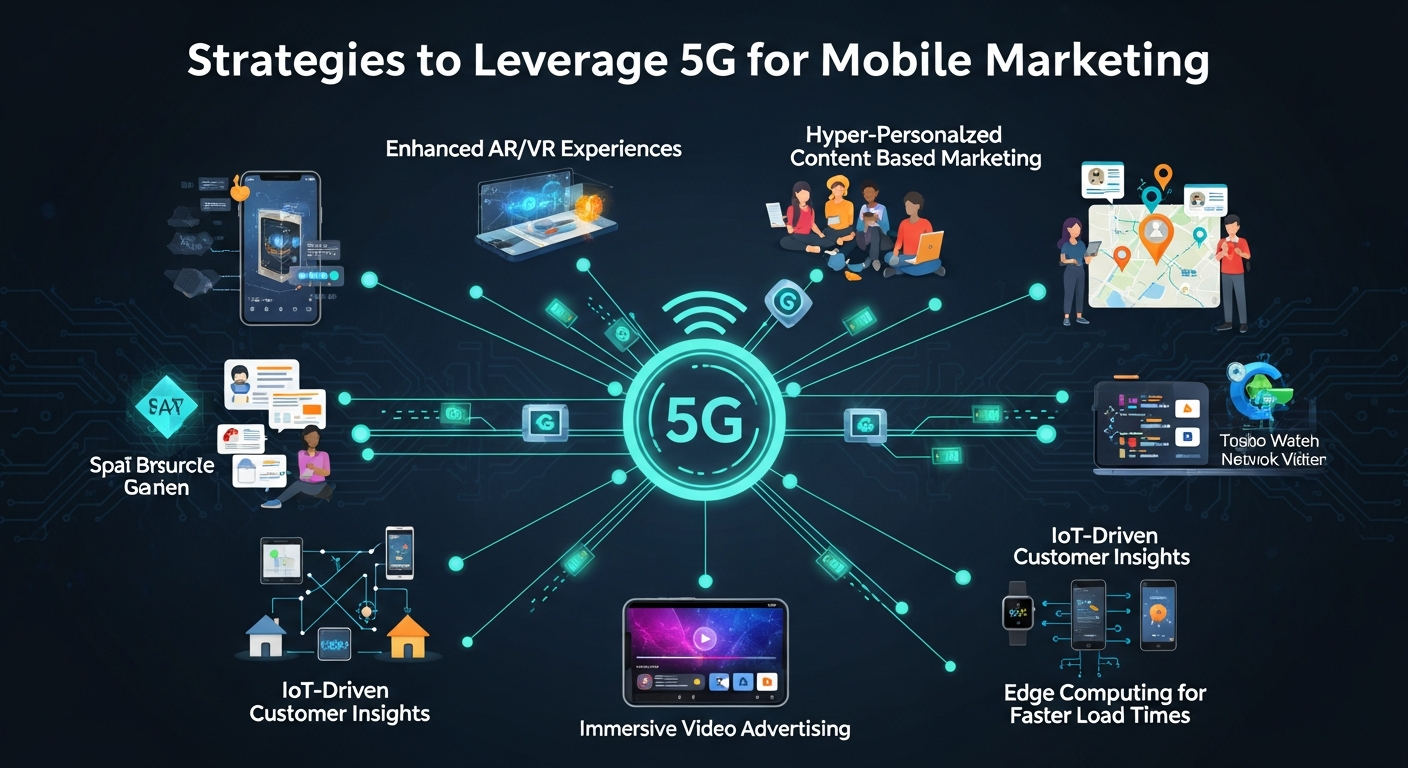
1. Optimize Media-Rich Content Delivery
Prepare your mobile apps and websites to handle high-resolution images, videos, and interactive elements efficiently. Use adaptive streaming protocols to adjust video quality in real time based on network speed, and employ modern image formats like AVIF or WebP to reduce file size without compromising quality. This ensures fast loading, smooth performance, and a superior user experience across devices and varying network conditions.
2. Implement Real-Time Personalization Engines
Integrate AI-driven personalization platforms that consume behavioral and contextual data with minimal delay. Use real-time bidding (RTB) in programmatic ad networks to adjust bids and creative assets dynamically, based on live user signals such as location, app usage patterns, or social sentiment.
3. Develop Immersive AR/VR Campaigns
4. Enhance Push and In-App Messaging with Geofencing
Use 5G-powered IoT sensors and beacons to trigger ultra-precise push notifications or in-app messages when a user enters or exits a specific location. For example, a retailer can send a limited-time offer for coffee when a customer is near a cafe, increasing foot traffic and conversions.
5. Leverage Edge Computing for Faster Data Processing
By deploying compute resources closer to users at the network edge, marketers can process interactions and campaign logic with minimal latency. Edge computing enables real-time analytics, allowing for instant insights and actions such as split-second A/B testing, dynamic pricing adjustments, personalized content delivery, and rapid fraud detection on mobile transactions. This approach ensures smoother, faster, and more responsive experiences for users while maximizing campaign efficiency.
Challenges and Considerations
While 5G brings unprecedented speed, low latency, and high-bandwidth capabilities, marketers must navigate several challenges to maximize its potential:
-
Infrastructure Variability
5G deployment is uneven across regions. Campaigns must be tested under mixed network conditions—4G, LTE, and 5G—to ensure users experience consistent performance regardless of connectivity. -
Data Privacy and Compliance
Real-time data collection can raise privacy concerns. Marketers must adhere to GDPR, CCPA, and other regulations, implementing clear consent flows, secure storage, and responsible data handling practices. -
Device Compatibility
Not all devices support 5G. Marketing campaigns should be backward-compatible, using responsive design to provide a seamless experience across older smartphones, tablets, and other devices. -
Content Overload
High-bandwidth capabilities allow for rich, interactive content, but this can overwhelm users. Prioritize quality, relevance, and value to maintain engagement and avoid fatigue.
Effectively addressing these challenges ensures that 5G-powered marketing campaigns are accessible, engaging, and trustworthy, allowing brands to fully leverage next-generation mobile technology.
Real-World Case Studies
Case Study 1: Virtual Showroom for Automotive Retail
A leading automobile manufacturer implemented a 5G-enabled mobile application to create a virtual showroom experience. The app streamed high-fidelity 3D models of their latest car models, allowing users to rotate vehicles, explore interiors, and customize colors and features in real time. Leveraging 5G’s low latency and high bandwidth, the app delivered smooth, immersive interactions that mimicked an in-person showroom visit. Customers could visualize every detail of the cars, compare options instantly, and share their customizations with friends or sales representatives. This innovative approach not only significantly enhanced customer engagement but also increased test-drive bookings by 40%, reduced foot traffic congestion in physical showrooms, and provided valuable data on user preferences to inform future marketing and product strategies.
Case Study 2: Live AR Fashion Try-On
A leading fashion retailer leveraged 5G connectivity to introduce an advanced AR feature in their mobile app, enabling customers to virtually try on clothing, footwear, and accessories in real time. The high-speed, low-latency 5G network ensured smooth rendering with realistic lighting, shadows, and accurate sizing. Users could experiment with multiple outfits quickly, share looks on social media, and make informed purchasing decisions without visiting a physical store. This immersive and interactive shopping experience increased user engagement, extended session durations by 55%, and boosted the average order value by 30%, demonstrating the power of 5G-driven AR for enhancing e-commerce performance and customer satisfaction.
Case Study 3: Hyperlocal Food Delivery Offers
A regional restaurant chain utilized geofencing and push notifications to deliver personalized meal deals when users were within 500 meters of a location. Thanks to low-latency 5G connectivity, coupon codes were delivered instantly, resulting in a 25% increase in same-day orders.
These case studies illustrate how 5G can enhance interactivity, personalization, and immediacy in mobile marketing, driving both engagement and measurable business results.
Future Outlook of 5G and Mobile Marketing
As 5G networks continue to expand and mature, mobile marketing is poised for transformative growth, offering faster, more immersive, and highly personalized experiences. Here’s what the future holds:
-
6G Research and Terahertz Communications
Early research into 6G and terahertz frequencies promises ultra-high-speed data transfers, potentially in multi-gigabyte-per-second ranges. This will enable next-generation ad formats like holographic displays, volumetric videos, and fully immersive AR/VR experiences on mobile devices, redefining user engagement. -
AI-Infused Edge Analytics
Edge computing combined with AI will allow real-time data processing directly on devices. Brands can deliver instant personalization while maintaining privacy, as sensitive data doesn’t need to leave the device. This enhances relevance, responsiveness, and customer satisfaction. -
Expanded IoT Ecosystem
The growth of connected devices—including smart cars, wearables, home devices, and other IoT technologies—will provide brands with new touchpoints. Marketing campaigns will evolve to create seamless, cross-device experiences, engaging users wherever they interact with technology. -
Blockchain-Based Verification
Blockchain technology will provide secure and transparent mechanisms for ad delivery and attribution. This ensures authenticity, reduces ad fraud, and builds trust between brands, advertisers, and consumers, making mobile advertising more accountable and effective.
In summary, the convergence of 5G speed, AI-driven edge analytics, an expanding IoT ecosystem, and blockchain security will reshape mobile marketing. Brands that adopt these technologies early will gain a competitive edge by delivering faster, more personalized, and highly immersive experiences.
Conclusion
The rollout of 5G is a catalyst for transformative mobile marketing strategies. By embracing enhanced speeds, real-time personalization, and immersive formats, forward-thinking brands can create richer experiences that drive engagement, loyalty, and revenue. However, success depends on thoughtful planning: optimize for diverse network environments, safeguard privacy, and focus on delivering genuine value to users. As we move into a hyperconnected future, 5G is not just a network upgrade—it’s the foundation for the next generation of mobile marketing innovation. Learn more about Mobile User Engagement: Your Complete Guide to Success.
FAQ: 5G and Mobile Marketing
1. What is 5G in simple terms?
5G is the fifth generation of wireless technology that provides much faster internet speeds, lower latency, and more stable connections than 4G. It enables high-quality video, AR/VR, and real-time data processing on mobile devices.
2. How does 5G improve mobile marketing?
5G allows marketers to deliver immersive videos, AR ads, hyper-personalized messages, and real-time offers. The fast speed and low latency create smoother mobile experiences, which boost engagement and conversions.
3. Why is low latency important for marketers?
Low latency means faster response time between a user’s action and the system’s reaction. This helps deliver real-time personalization, live AR experiences, instant push notifications, and smoother app performance.
4. Can businesses use 5G for hyperlocal marketing?
Yes. 5G enhances geofencing accuracy and IoT sensor connectivity, allowing brands to send location-based offers the moment a user enters a specific area.
5. Do all users need a 5G phone to experience these features?
No. Marketers should design campaigns that work on both 4G and 5G devices. However, users with 5G-enabled phones will experience richer and faster mobile content.
6. Are there any challenges in using 5G for marketing?
Yes. Challenges include uneven 5G coverage, ensuring data privacy compliance, device limitations, and avoiding content overload for users.
7. How does 5G support AR and VR marketing campaigns?
5G provides the bandwidth and speed required to run high-quality AR/VR experiences smoothly on mobile devices—like virtual try-ons or 3D product demos.
8. Will 5G impact mobile advertising costs?
Possibly. Immersive formats like 360° video or AR ads may be more expensive to produce, but they offer higher engagement and stronger ROI.
9. What industries will benefit the most from 5G-powered marketing?
Retail, real estate, automotive, gaming, tourism, education, and entertainment will see strong benefits due to the need for immersive, real-time, and interactive experiences.
10. What is the future of 5G in marketing?
5G will pave the way for next-level innovations like holographic ads, edge-based AI personalization, expanded IoT ecosystems, and more precise digital experiences.