Mobile App Marketing: Your Complete Guide to Success

Mobile app marketing drives user acquisition, engagement, retention, and revenue through strategic planning, ASO, paid ads, and analytics. By focusing on onboarding, personalization, and long-term growth, businesses can maximize app visibility and lifetime value. A data-driven approach ensures scalable success in competitive mobile marketplaces.
Mobile applications have become the cornerstone of digital engagement, with users spending over 7 hours daily on their smartphones. For businesses, this presents an unprecedented opportunity to connect with customers through targeted mobile app marketing strategies.
Marketing with mobile apps goes beyond simply having your business listed on app stores. It encompasses a comprehensive approach that includes user acquisition, engagement, retention, and monetization through strategic mobile platforms. Whether you’re launching a brand-new app or looking to revitalize an existing one, understanding the nuances of mobile app marketing can dramatically impact your success.
Understanding Mobile App Marketing Fundamentals
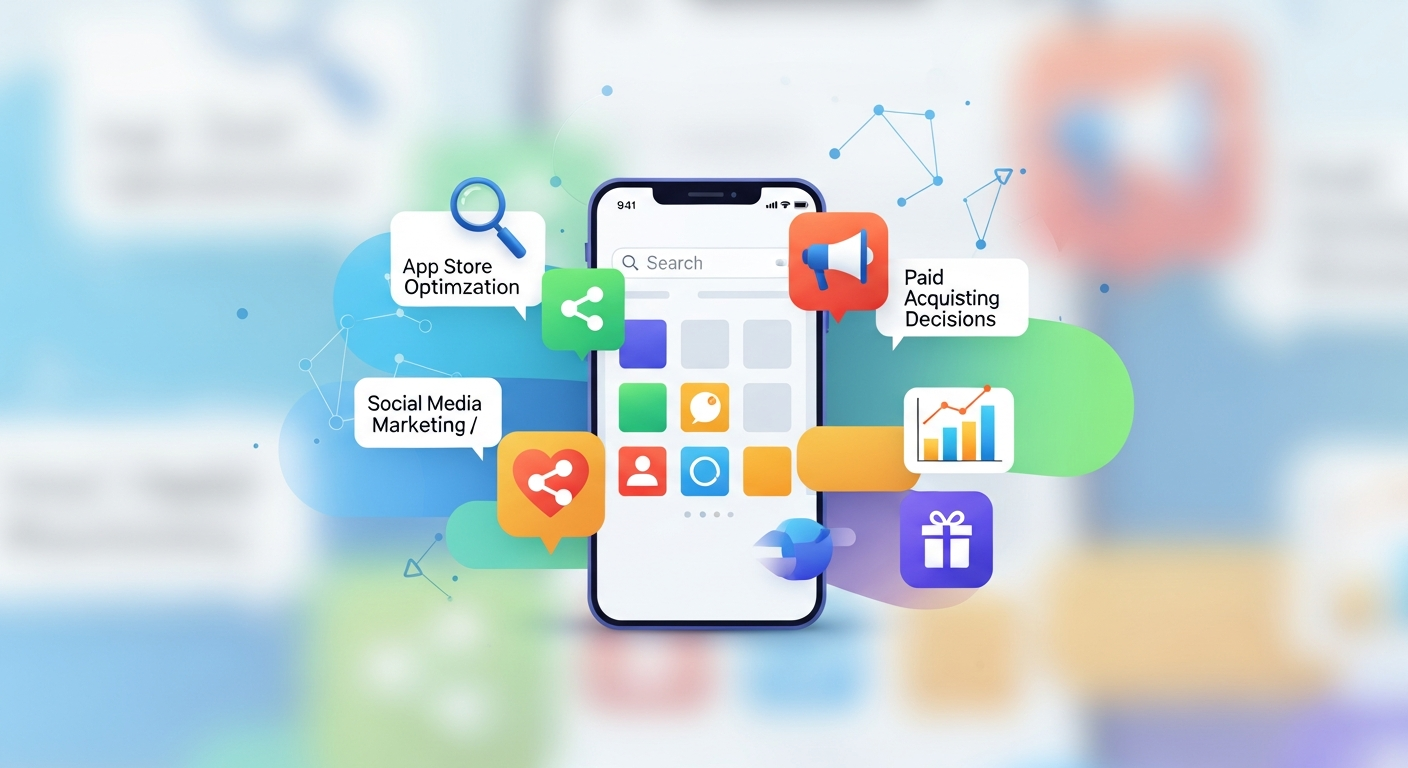
Mobile app marketing differs significantly from traditional digital marketing approaches. While web-based marketing focuses on driving traffic to websites, mobile app marketing centers on encouraging downloads, fostering user engagement, and building long-term app loyalty.
The mobile app ecosystem operates on unique principles. Users discover apps through various channels including app stores, social media, word-of-mouth recommendations, and paid advertising campaigns. Once downloaded, the real challenge begins: keeping users active and engaged beyond the initial install.
Successful mobile app marketing requires understanding user behavior patterns specific to mobile devices. Mobile users expect instant gratification, seamless experiences, and personalized content. They’re also more likely to abandon apps quickly if their initial experience doesn’t meet expectations.
App store algorithms play a crucial role in app discoverability. These algorithms consider factors like download velocity, user ratings, reviews, and keyword relevance when determining app rankings. Understanding these ranking factors helps inform your overall marketing strategy and resource allocation.
Pre-Launch Mobile App Marketing Strategies
Before your app hits the app stores, laying solid groundwork through pre-launch marketing can significantly impact your launch success. Building anticipation and generating buzz before launch day creates momentum that carries into your official release.
Start by creating a landing page specifically for your upcoming app. This page should highlight key features, showcase screenshots or demo videos, and include an email signup form for interested users. Search engine optimization for this landing page helps establish early visibility and drives organic traffic.
Social media platforms offer excellent opportunities for pre-launch buzz generation. Share behind-the-scenes development updates, feature previews, and countdown posts to build excitement among your target audience. Consider creating teaser videos that demonstrate your app’s core value proposition without revealing everything.
Beta testing programs serve dual purposes: they help identify bugs and usability issues while creating a community of early adopters who can become your app’s first advocates. Beta testers often provide valuable feedback and may leave positive reviews once your app launches publicly.
Influencer partnerships can amplify your pre-launch efforts significantly. Identify influencers whose audiences align with your target users and collaborate on content that generates awareness about your upcoming app launch.
App Store Optimization (ASO) Essentials
App Store Optimization functions as the SEO equivalent for mobile applications. Just as websites need optimization to rank well in search engines, apps require optimization to appear prominently in app store search results.
Your app title serves as the most important ranking factor. Include your primary keyword while keeping the title memorable and descriptive. Apple’s App Store allows up to 30 characters for app titles, while Google Play provides more flexibility with up to 50 characters.
App descriptions should clearly communicate your app’s value proposition while naturally incorporating relevant keywords. Focus on benefits rather than just features, and use bullet points or short paragraphs to improve readability. The first few lines are particularly important since they appear in search results.
Screenshots and app preview videos significantly influence download decisions. Create compelling visuals that showcase your app’s best features and user interface. Consider using captions or annotations on screenshots to highlight key benefits and functionality.
Encouraging positive reviews and ratings requires ongoing effort but pays substantial dividends. High ratings improve your app’s credibility and search rankings. Respond promptly to user reviews, especially negative ones, to demonstrate your commitment to user satisfaction.
Paid Advertising for Mobile Apps
Paid advertising accelerates user acquisition and helps overcome the initial visibility challenges that new apps face. Multiple advertising platforms offer sophisticated targeting options specifically designed for mobile app promotion.
Apple Search Ads provide direct placement within App Store search results, making them highly effective for capturing users with strong download intent. These ads appear at the top of search results and blend naturally with organic listings.
Google Ads offers Universal App Campaigns that automatically optimize ad placement across Google Search, YouTube, Google Play, and the Google Display Network. These campaigns use machine learning to find users most likely to install and engage with your app.
Social media advertising platforms like Facebook, Instagram, and TikTok excel at mobile app promotion due to their predominantly mobile user bases. These platforms offer detailed targeting options based on demographics, interests, behaviors, and lookalike audiences.
When running paid campaigns, focus on metrics beyond just installs. Cost per install (CPI) provides basic insight, but lifetime value (LTV) and retention rates offer better indicators of campaign effectiveness. Track user actions within your app to understand which advertising sources deliver the highest-quality users.
User Engagement and Retention Strategies
Acquiring app downloads represents just the beginning of successful mobile app marketing. Keeping users engaged and active requires ongoing effort and strategic thinking about user experience and value delivery.
Push notifications remain one of the most direct ways to re-engage app users. However, timing, frequency, and relevance are crucial factors that determine whether push notifications drive engagement or prompt app deletions. Personalize notifications based on user behavior, preferences, and time zones.
In-app messaging allows for more contextual communication than push notifications. Use in-app messages to guide new users through key features, announce updates, or promote relevant content based on user actions within your app.
Gamification elements like achievements, badges, progress tracking, and leaderboards can significantly boost user engagement. These features tap into psychological motivators that encourage continued app usage and create positive associations with your brand.
Regular content updates keep your app fresh and provide reasons for users to return. Whether it’s new features, seasonal content, or user-generated content integration, consistent updates demonstrate ongoing value and commitment to user experience.
Measuring Mobile App Marketing Success
Tracking the right metrics helps you understand what’s working in your mobile app marketing efforts and where improvements are needed. Different metrics matter at various stages of the user journey.
Download metrics provide initial insight into your app’s market appeal. Track total downloads, download velocity, and conversion rates from various marketing channels. However, downloads alone don’t indicate success since many users abandon apps quickly after installation.
User engagement metrics like session duration, screens per session, and daily active users (DAU) reveal how effectively your app holds user attention. Monthly active users (MAU) help identify longer-term engagement trends.
Retention rates are perhaps the most critical metrics for app success. Day 1, Day 7, and Day 30 retention rates show how well your app meets user expectations and provides ongoing value. Industry benchmarks vary, but strong apps typically see 20% retention rates at 30 days.
Revenue metrics depend on your app’s monetization model. Track average revenue per user (ARPU), lifetime value (LTV), and return on ad spend (ROAS) to understand the financial effectiveness of your marketing investments.
Building Long-Term App Growth
Sustainable mobile app marketing requires thinking beyond initial launch campaigns toward building systems that support ongoing growth and user acquisition through organic channels.
App Store featuring opportunities can dramatically boost visibility and downloads. Apple and Google regularly feature apps that demonstrate innovation, excellent user experience, or seasonal relevance. While featuring can’t be guaranteed, following app store guidelines and maintaining high-quality standards improves your chances.
Referral programs leverage your existing user base to acquire new users. Successful referral programs offer meaningful incentives to both referrers and new users while making the sharing process simple and natural.
Content marketing supports app marketing by providing valuable information related to your app’s purpose or industry. Blog posts, videos, podcasts, and social media content can drive awareness and establish your brand as an authority in your space.
Partnerships with complementary apps or services can create mutually beneficial user acquisition opportunities. Cross-promotion, integration partnerships, or joint marketing campaigns can expand your reach to relevant audiences.
Your Path to Mobile App Marketing Success

Mobile app marketing success requires a comprehensive approach that extends from pre-launch preparation through long-term growth strategies. The mobile app landscape continues evolving rapidly, making adaptability and continuous learning essential for sustained success.
Start by establishing strong foundations with app store optimization and clear value proposition communication. Build upon these foundations with targeted advertising campaigns and robust user engagement strategies. Most importantly, maintain focus on providing genuine value to users, as satisfied users become your most powerful marketing advocates.
Consider conducting an audit of your current mobile app marketing efforts using the strategies outlined in this guide. Identify areas where you can implement immediate improvements, then develop a longer-term roadmap for sustained growth and user acquisition.
Conclusion
Mobile app marketing is a continuous process that extends far beyond app launches. By combining strategic planning, ASO, paid acquisition, engagement tactics, and analytics, businesses can build scalable growth engines. Apps that prioritize user experience, personalization, and long-term value consistently outperform competitors. A data-driven, user-centric approach ensures sustained visibility, retention, and profitability in an ever-evolving mobile ecosystem.
FAQs About Mobile App Marketing
1. What is mobile app marketing?
Mobile app marketing is the strategic process of promoting a mobile application to acquire new users, increase app installs, boost user engagement, improve retention rates, and generate revenue across iOS and Android platforms. It covers the full user lifecycle, from discovery and download to long-term usage and monetization.
2. Why is mobile app marketing important for businesses?
Mobile app marketing is important because it helps apps gain visibility in crowded app stores, attract high-quality users, build brand loyalty, and achieve sustainable growth. Without proper marketing, even well-designed apps struggle to reach their target audience or generate consistent engagement.
3. How does mobile app marketing differ from traditional digital marketing?
Mobile app marketing focuses on app installs, in-app engagement, retention, and lifetime value, whereas digital marketing primarily drives website traffic, leads, and online conversions. App marketing also involves app store optimization, onboarding flows, and push notification strategies unique to mobile platforms.
4. What are the main mobile app marketing channels?
The primary mobile app marketing channels include app stores, paid advertising platforms, social media marketing, influencer partnerships, content marketing, referral programs, email marketing, and push notifications. A successful strategy combines multiple channels to drive both organic and paid growth.
5. What is App Store Optimization (ASO) in mobile app marketing?
App Store Optimization (ASO) is the process of improving an app’s visibility and conversion rate within app stores by optimizing keywords, app titles, descriptions, screenshots, preview videos, ratings, and reviews. ASO helps apps rank higher and attract more organic installs.
6. How do paid ads help mobile app marketing efforts?
Paid advertising helps mobile apps accelerate user acquisition, increase brand visibility, and scale faster. Platforms like Google Ads, Apple Search Ads, Facebook, Instagram, and TikTok allow precise audience targeting, helping apps reach users who are more likely to install and engage.
7. What metrics are used to measure mobile app marketing success?
Key mobile app marketing metrics include total downloads, cost per install (CPI), retention rates, daily and monthly active users (DAU/MAU), engagement levels, lifetime value (LTV), churn rate, and return on ad spend (ROAS). These metrics indicate both growth and profitability.
8. Why is user retention important in mobile app marketing?
User retention is critical because retaining existing users is more cost-effective than acquiring new ones. High retention rates increase lifetime value, improve app store rankings, strengthen brand loyalty, and drive long-term revenue growth for mobile applications.
9. How do push notifications improve mobile app engagement?
Push notifications help re-engage users by delivering timely, personalized, and relevant messages directly to their devices. When used strategically, push notifications encourage repeat usage, promote features, and increase session frequency without overwhelming users.
10. What role does onboarding play in mobile app success?
Onboarding introduces users to an app’s core features and value quickly. A smooth onboarding experience reduces early churn, improves user understanding, and increases long-term adoption by ensuring users know how the app benefits them from the first interaction.
11. Can small businesses benefit from mobile app marketing?
Yes, small businesses can benefit greatly from mobile app marketing. Scalable strategies such as ASO, content marketing, referral programs, and targeted paid ads allow small brands to compete effectively without large budgets while building loyal user communities.
12. What is a long-term mobile app growth strategy?
A long-term mobile app growth strategy focuses on user retention, organic acquisition, continuous optimization, regular updates, and customer satisfaction. Instead of relying only on paid installs, it builds sustainable growth through engagement, referrals, and long-term value creation.